By Stavros Mastrogiannis | Body Reset Specialist | Live Your Way Thin & Healthy
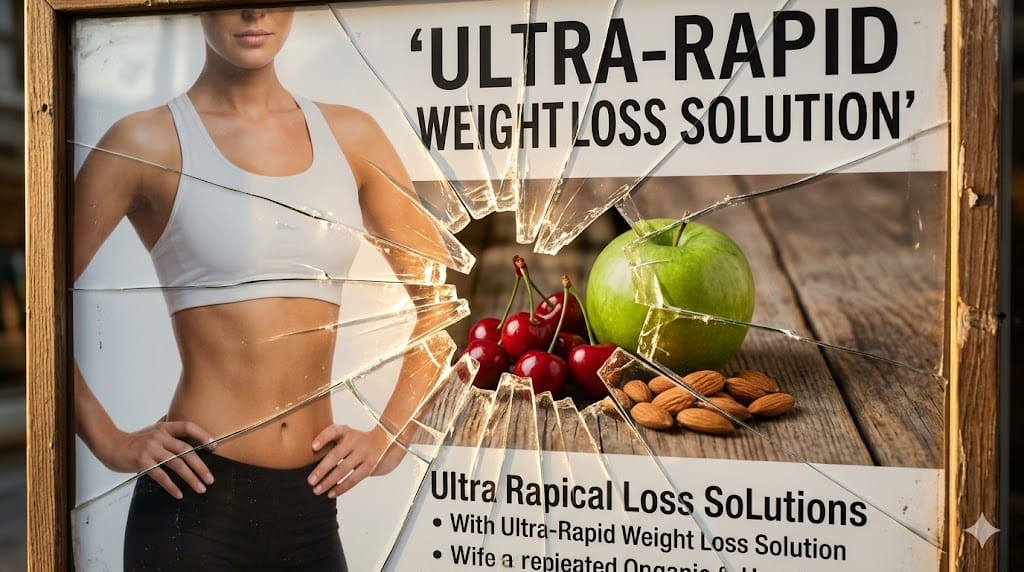
If you have ever lost weight on a program only to gain it all back — sometimes more than you lost — you have probably blamed yourself. Your willpower. Your discipline. Your inability to stick with anything.
I want to tell you something that 30 years of coaching and over 1,500 clients has taught me with absolute certainty:
It was never your fault.
The program failed you. And it failed you in a very specific, very predictable way — one that the weight loss industry has known about for decades and chosen to ignore, because fixing it would be bad for business.
Let me explain.
Weight Loss Is a Lagging Indicator — And Nobody Tells You This
In business, a lagging indicator is a result that shows up after the work that caused it. A company makes a smart decision today, but revenue does not jump tomorrow. It shows up weeks or months later, after that decision has had time to compound. The cause and the visible result are always separated by time.
Weight loss works exactly the same way.
You take action today. You take action tomorrow. You keep taking action. And for a while — nothing on the scale. Not because the actions are not working. But because the body does not respond to a single action. It responds to the accumulation of actions over time.
This is where most people make a fatal mistake — and it is not entirely their fault. The weight loss industry has spent decades training people to measure success by one thing and one thing only: the number on the scale. So that is exactly where they look. They take a few steps, check the scale, see nothing, and conclude the process is not working. So they stop — right at the moment they were actually making progress.
They quit not because they failed. But because they misread the timing. The industry conditioned them to look in the wrong place, and then quietly blamed them when they lost faith in the process.
Think of it like pushing a boulder. Each push may not move it visibly — but do not mistake invisible for ineffective. Every push slightly destabilizes the boulder. It shifts its center of gravity just a fraction. It loosens the ground beneath it. And at some point — because of every push that came before — it tips past its balance point and begins to roll. The final push did not do all the work. It simply got the credit. Every push before it made that moment possible.
Your body works the same way. Every healthy action you take is destabilizing the old pattern — even when the scale has not moved yet.
The Industry’s Dirty Secret: They Sell You Speed Because Speed Sells
If the lagging indicator is simply how the body works, why does virtually no weight loss program ever explain it?
Because it does not sell.
“Your results will come — just stay consistent over the next several months” does not fill boot camps or move detox kits off shelves. The weight loss industry runs on urgency and the promise of speed. So instead of explaining the lagging indicator — the most important thing you could possibly understand about how your body works — they bury it and sell you the opposite: fast results through massive action.
Here is the problem with massive action.
Every simultaneous change demands willpower, adjustment, sacrifice, and discomfort. One change is manageable. Two is harder. Three becomes a grind. By the time you are running six new demands on your life at once — a new diet, a new exercise routine, no alcohol, no sugar, tracking every meal — you are not building healthy habits. You are white-knuckling your way through a temporary performance that your body and mind are already plotting to abandon.
Think of it like the straw that broke the camel’s back. Each new demand piled onto your willpower is another straw. And at some point, no matter how strong you are, the whole thing gives out. Not because you are weak. Because no camel, no matter how strong, was built to carry an unlimited load.
Massive action does not create lasting change. It creates the appearance of change — for exactly as long as sheer willpower can sustain it. And willpower is not an infinite resource. When it runs out, everything collapses at once — because everything was built at once.
The industry calls this “falling off the wagon.” What it actually is, is the entirely predictable result of a model designed to burn you out — and then sell you the next program when you come back.
The Proof Is in the Programs You Already Know
You do not have to take my word for any of this. Just look at the most popular weight loss approaches in the world and ask one simple question: do they have you make changes gradually, one at a time, with plenty of time to adapt — or do they hand you an entirely new way of living from day one?
Weight Watchers (WW): From the moment you join, you are tracking every single thing you eat using a points system. Your entire relationship with food changes immediately. All at once, from day one.
Nutrisystem: Replaces your food entirely with pre-packaged meals. Total dietary overhaul, immediately.
Keto: Eliminates an entire macronutrient — carbohydrates — overnight. Your body, which has been running on glucose for your entire life, is forced to switch its primary fuel source within days. That is not a small adjustment. That is a metabolic earthquake.
Intermittent Fasting: Compresses your entire eating window, often cutting it in half, starting immediately. Your hunger signals, your social eating patterns, your morning routine — all disrupted at once.
Some programs do introduce changes in phases. But look closely at how much time they give you to truly adapt before piling on the next. It is almost never enough. Because “enough time” does not fit on a marketing calendar. “Lose weight fast” does.
The pattern is identical across all of them: immediate, sweeping, total transformation. And the results are identical too — short-term success followed by long-term failure, repeated endlessly, with the blame quietly placed on the person rather than the method.
What the Science Actually Says: The Kaizen Approach
There is a philosophy from Japanese manufacturing that explains everything the weight loss industry gets wrong. It is called Kaizen — and it means continuous improvement through small, deliberate steps.
Toyota used Kaizen to become the most efficient car manufacturer on the planet — not through dramatic overhauls, but through tiny, consistent improvements compounded over time. The philosophy spread into business, medicine, athletics, and psychology because it kept producing the same result: lasting, sustainable transformation that wholesale revolution never achieved.
Every industry eventually figured this out. Every industry, that is, except the weight loss industry — because “slow and steady” does not sound nearly as sexy and attractive as “lose 20 lbs in a month or less.”
Here is why Kaizen works, at the level of brain science.
Every habit exists as a physical structure in your brain — neural pathways reinforced through repetition, wrapped in a coating called myelin that makes each behavior faster and more automatic over time. Research from University College London found that a new behavior takes 66 days to become truly automatic. To be fair, 21 days is roughly how long it takes to become comfortable with a new behavior — but comfortable is not the same as habitual. Habitual means it runs on autopilot, without conscious thought or willpower. That takes the full 66 days — and that is for one behavior in isolation.
When you ask your brain to absorb six new behaviors at once, it cannot give any of them the dedicated repetition they need to become automatic. Nothing gets locked in. Everything stays in the effortful, willpower-dependent zone — which is exactly where burnout lives.
There is also a neurological reason why small changes work better than large ones. Large, sudden changes activate the amygdala — the brain’s threat-detection center — which responds to major life disruptions the same way it responds to physical danger: with resistance, anxiety, and the urge to return to the familiar. This is why dramatic diet changes feel like deprivation even when you intellectually want to make them. Your own brain is fighting back.
Small changes fly under the amygdala’s radar. They slip into your life quietly, take root, and begin to feel normal before your brain has a chance to resist.
The Problem Nobody Talks About: Conventional Behaviors Can Never Become Habitual
Even if a conventional weight loss program slowed down — even if it introduced changes one at a time — there is a second problem that almost nobody addresses.
The behaviors themselves.
Think about what most programs actually ask you to do. Count your points. Track your macros. Weigh your portions. Log every meal. These are not habits. These are systems — and systems require constant, conscious effort to maintain.
A true habit eventually becomes automatic. It stops requiring willpower. It fades into the background of your life. But you will never wake up one morning and automatically count your macros without thinking about it. These behaviors, by their very nature, live permanently in the conscious, effortful zone of your brain. They never get easier. They demand the same amount of attention on day 500 as they did on day one.
This is why people who succeed on these programs still feel like they are “on a diet” years later. Because they are. There is no graduation. The vigilance is the price of admission — forever.
The behaviors we focus on are fundamentally different. Eating only when genuinely hungry. Eating slowly and stopping when satisfied. Moving your body in ways you enjoy. Managing stress before it drives you to the refrigerator. These are behaviors that can become automatic. They can become simply how you live — effortless, invisible, and permanent.
That is the difference between a program that manages your weight and a program that resets it.
The Problem That Goes Even Deeper: Identity
Here is something most weight loss programs will never tell you, because it would expose the deepest flaw in their entire approach.
You can do everything right. You can lose the weight, build the habits, stay the course. And still end up right back where you started. Not because you failed. But because sustainable weight loss has one final requirement that goes deeper than food, deeper than exercise, deeper than habits — and virtually every program on the market completely ignores it.
It is the piece that determines whether your results last a lifetime or fade within a year. And once you understand it, you will never look at weight loss — or yourself — the same way again.
It comes down to this: how you identify yourself. And the thoughts you have been believing about what is possible for you.
Your brain acts as a powerful filter — constantly scanning your environment for evidence that confirms who you believe yourself to be, and screening out evidence that contradicts it. You experience this every day without realizing it: the moment you decide to buy a particular car, you suddenly start seeing that exact car everywhere. Those cars were always there. You just were not looking for them.
The same mechanism governs your relationship with your body and your health. If your identity — the story you carry about yourself — includes the belief that you are someone who cannot maintain a healthy weight, your brain will find proof of that belief everywhere. Every slip becomes confirmation. Every plateau becomes expected.
Harvard psychologist Ellen Langer demonstrated this in a landmark study: when hotel maids were told that their daily work qualified as the kind of exercise recommended for a healthy lifestyle — without changing anything they actually did — they lost weight, lowered their blood pressure, and improved their body mass index compared to a control group. Their perception of themselves literally changed their physical outcomes. Nothing else changed. Just the story they were living inside.
And then there is the sequence that most programs completely ignore:
Thought → Emotion → Behavior → Result
Every behavior you have begins as a thought. That thought triggers an emotion. That emotion drives the behavior. And that behavior produces the result. If you try to change the behavior without first changing the thought that is generating it, you are fighting an uphill battle that you are most likely going to lose.
You can white-knuckle a new behavior for days, weeks, even months. But the moment your guard drops, the old thought reasserts itself. And the old thought produces the old emotion. And the old emotion drives the old behavior. And you are right back where you started.
Nothing is wrong with you. You just started in the wrong place.
The Third Choice Nobody Offered You
The fitness industry has spent decades obsessing over one question: what is the fastest way to get people to lose weight? Not the most livable way. Not the most sustainable way. The fastest — because fast weight loss is what sells programs, fills gyms, and moves product off shelves.
In doing so, they forgot something fundamental: people do not live to exercise and watch their diet. They want a lean, healthy body so they can live better. But here is the trap nobody names out loud: what is the point of having a lean, healthy body if maintaining it makes your life miserable?
With the conventional approach, you are offered exactly two choices.
Choice One: Dedicate your life to fitness. Make food tracking, calorie counting, and structured exercise the organizing principle of your existence. This works — but only if you genuinely love making your life all about fitness. For most people, it is a full-time job they never signed up for and eventually quit.
Choice Two: Let it go. Stop fighting. Enjoy your life on your own terms, at least for now. Accept the trade-off — overweight and unhealthy — and quietly carry the growing worry about what your current habits are building toward: the fatigue, the disease, the medical bills, the lost mobility in your later years, and a shorter life than you deserved.
Most people cycle between these two choices their entire lives. The industry calls this yo-yo dieting. What it actually is, is a person desperately searching for a third option that nobody ever told them existed.
We started with a completely different question: what is the most liveable way to lose weight?
That single shift in perspective changed everything. Because when you stop optimizing for speed and start optimizing for livability, you stop fighting human nature and start working with it. You stop prescribing behaviors that require permanent willpower and start building behaviors that can become genuinely automatic — effortless, invisible, and permanent.
The result is not a diet. It is not a fitness regimen. It is a reset — a gradual, sustainable rebuilding of the habits your body needs to maintain itself lean and healthy naturally, the way it was always designed to.
A diet changes what you do. A reset changes who you are. And that is why the results last.
What 30 Years and 1,500 Clients Has Taught Me
In over 30 years of coaching and more than 1,500 clients, I have never — not once — had a client who consistently followed all the steps I recommend and did not lose weight. Not one.
I have also had clients who did not follow the steps. And without exception, they did not lose weight.
That is not a coincidence. That is cause and effect, playing out the same way, every single time, regardless of age, hormones, metabolism, or history.
Weight loss is not a mystery. It is not luck. It is not determined by your genetics or your willpower.
It is the inevitable result of a specific set of actions, taken consistently, over time.
Inevitable.
The only thing standing between you and that result is whether you take the actions — and whether you stay in the process long enough for the lagging indicator to catch up.
A Final Question
For those of you who want fast results, I want to ask you one honest question.
What is the point of losing weight fast if you are just going to gain it all back?
Would you not rather take a few extra months — not years, just months — lose the weight the right way, and never have to think about this again?
The fast way costs you years of frustration. The right way costs you a few extra months. The choice is that simple.
Your Next Step
If what you read here resonated with you — if you are tired of the cycle and ready to finally approach your health the way the science says it actually works — here is one way to go deeper:
Book a Free Discovery Session If you are ready to talk about what this looks like specifically for you — your habits, your history, your tipping point — book a free 30 to 45 minute Discovery Session. No pressure, no obligation. Just an honest conversation about what is possible for you. Available in person at our Danbury, CT facility or online from anywhere in the country.
Book Your Free Discovery Session →
Stavros Mastrogiannis is a Body Reset Specialist with 30+ years of experience and 1,500+ clients. He is the founder of Live Your Way Thin & Healthy in Danbury, CT and the creator of the Body Reset Protocol. His practice serves clients in person locally and online nationwide.
© 2026 Live Your Way Thin LLC | liveyourwaythin.com | (203) 778-9545