
I didn't get into the fitness industry because I loved working out. I got into it because I hated it — and I knew that made me the only trainer in Danbury who actually understood what my clients were going through.
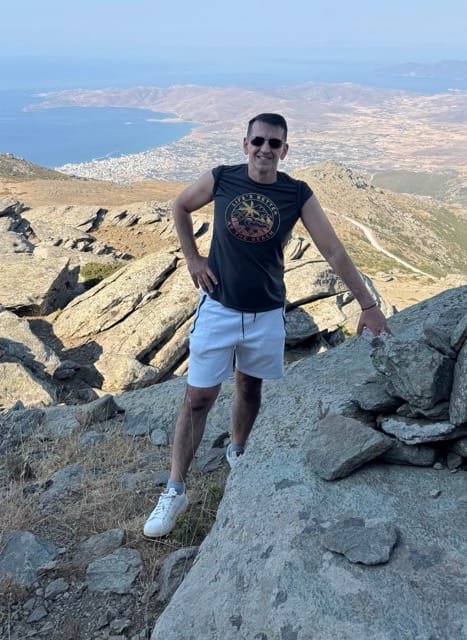
"Most fitness professionals think the goal is to help people find more motivation to exercise and eat healthy. That's the wrong goal. The goal is to help people make healthy living need no motivation at all — to have it run quietly in the background of your life, the way it did for the people in my Greek village, so you can focus your energy on actually living."— Stavros Mastrogiannis
Imagine growing up in Greece in the 1970s and 80s where virtually everyone around you was lean, energetic, and healthy well into their 80s and 90s. Where cancer was something you heard about rarely. Where out of 350 children in your entire school, maybe three were overweight.
That was Stavros's world. And nobody — not a single person he knew — was on a diet. Nobody counted calories. People simply lived, ate naturally, moved through their days, and stayed lean without effort or obsession.
At the time, he didn't think much of it. It was just life. He had no idea that the quiet wisdom baked into that island culture would one day become the foundation of the most effective sustainable weight loss approach he had ever encountered.
"In my village, staying lean into your 90s wasn't an achievement. It was just what happened when your body worked the way it was designed to."
It would take him 30 years, two careers, and one life-changing question from his mother to fully understand what he had witnessed as a child.
At 15, Stavros moved to Danbury, Connecticut to live with his uncle Jimmy and aunt Maggie. He could barely speak English. His new school had more than 2,000 students — six times the population of his entire school back in Greece. He was disoriented, and quietly furious at his father for a decision that had cost him a head start in America.
His uncle did something that annoyed Stavros enormously at the time: after three months, he banned Greek in the house. English only. If Stavros spoke Greek, no one responded. Sink or swim.
Within a year, Stavros was fluent. Within two, he made the honor roll at Danbury High School.
"Being forced to adapt to something uncomfortable, building a new skill from nothing — that experience shaped how I approached every major challenge that followed."
That lesson — that discomfort and constraint could produce extraordinary capability — would shape his approach to everything that followed. Including the challenge that would define his life's work.
Stavros's family was in the restaurant business. So he enrolled at The Culinary Institute of America — one of the most prestigious culinary schools in the world. He was good at it. But during a six-month internship at the Boston Harbor Hotel, something gnawed at him. He didn't love it.
What he was actually obsessed with — in the little time he had between shifts — was health, fitness, and a question that had bothered him since his gym days: why couldn't he stay consistent with any exercise program? He'd start strong, last a few weeks, and quit. Trainers told him the "high" from working out would kick in eventually. It never happened.
One morning, getting ready for another day at a job he dreaded, Stavros glanced at his calendar. The quote read: "If you love what you do for a living, you will never work a day in your life."
He stood there for a long moment. Then he made a decision.
"I was going to become a fitness professional — not because I loved exercise, but precisely because I didn't. Most people are exactly like me. And nobody was helping those people."
By 1999, Stavros had opened his private Danbury facility, built a thriving client base, and gotten certified in one of the most respected nutrition systems of the era. His clients were seeing results. But they still weren't keeping the weight off long-term.
Then his mother asked him something simple. "How come you tell your clients that breakfast is the most important meal of the day? Did you eat breakfast in Greece?"
He stopped. On the Greek island where he grew up, most adults didn't eat breakfast. Children sometimes did, sometimes didn't. Nobody made a big deal of it. And those people — the ones skipping the "most important meal of the day" — were among the leanest, longest-lived people he had ever known.
His mother's question cracked something open in his thinking. He had been treating his certifications as truth — as if a credential stamped on paper made an idea correct. But he had seen the contradiction with his own eyes his entire childhood.
"I realized I needed to question everything. No matter how established the idea. Just because a study supports something doesn't make it true."
What followed was fifteen years of obsessive research — not the kind that leads deeper into the mainstream, but the kind that deliberately seeks out contradictions.
The insight that changed everything was deceptively simple: the weight is not the problem. The weight is the symptom.
The problem is the habitual behaviors that caused the weight gain in the first place. And virtually every weight loss program attacks the symptom — the number on the scale — while leaving the root cause completely untouched.
You can force weight off through calorie restriction and brutal exercise. The weight loss industry has been doing exactly that, very effectively, for decades. What it cannot do is make that weight stay off — because the habits that caused it are still running in the background, unchanged.
Once Stavros understood this, the entire architecture of his program shifted. Instead of designing a weight loss system, he designed a habit-change system — one that identified the behaviors all naturally lean populations share, and introduced them gradually, in a sequence that worked with human nature instead of fighting it.
"I didn't get into this field to help people lose weight temporarily. If the results don't last, I didn't actually solve anything."
The results were unlike anything his clients had experienced before. Not just in losing the weight — they had always been able to do that. The difference was in keeping it off. He started receiving emails from people he hadn't spoken to in a decade, telling him the weight had stayed off. Those emails, he says, are still the best part of his work.
These aren't marketing lines. They're the conclusions Stavros arrived at after 30 years of watching what works — and what doesn't.
The people Stavros works with are disciplined, successful, capable humans. The reason weight management has been hard isn't character. It's that every program they've tried has taught them to manage a broken system, not repair it.
You should be able to enjoy a meal in a restaurant without guilt. You should have the energy to play with your grandkids without pain. Health that requires permanent vigilance isn't health — it's a different kind of trapped.
Most fitness businesses are built on dependency — they need you to need them. Stavros's mission since 1996 has been the opposite: repair what's broken so thoroughly that you eventually don't need anyone to manage your weight ever again.
The asteroid doesn't change course because of an explosion. It changes course because of a precise, consistent force applied in the right direction. The same is true of every lasting behavior change he has ever witnessed.
The people in his Greek village ate bread, drank wine, and used olive oil on everything. They weren't perfect — they just had systems that worked. Perfection is the enemy of sustainability. Good enough, consistently, beats perfect occasionally every single time.
The thing Stavros resented most as a teenager — his father's decision to move the family back to Greece — turned out to give him the one credential no other trainer in Danbury has: he saw effortless health with his own eyes, every day, for 15 years. Sometimes the thing that sets you back is actually setting you up.
After 30+ years, 1,500+ clients, and more research hours than he cares to count, this is where it all landed: a private facility on Mill Plain Road in Danbury, a system that works, and a phone that still gets emails from clients who finished the program a decade ago — and never needed to start over.
If that sounds like what you've been looking for, the next step is a conversation.
In one honest conversation — in person at the Mill Plain Road facility or online — Stavros will identify which of your four systems needs the most attention and show you exactly what the Body Reset Protocol would look like for your life.
Discover how to reset your body to work the way it was designed — so lean and healthy become your natural outcome.
No obligation · No pressure · Walk away with real insights either way · 18 Mill Plain Rd, Danbury CT